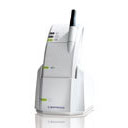
CardioMessenger II Remote Monitor from BIOTRONIK
CardioMessenger® is the link that connects the patient to his physician. It's a simple, ……...


Micro-Epsilon’s capacitive sensors have established themselves in numerous different applications over several years. Dependable technology allows the sensors to be employed in safety-critical areas. Over 25 basic sensors with measuring ranges from 50 µm to 10 mm cover many fields of application. These sensor versions are available as cylindrical models with a connector, as well as with in-built cable, in PCB designs, and as a flat sensor.
Unique Sensor Design/Probe Design
The totally triaxial sensor design is unique for capaNCDT sensors (also referred to as probes), where the guard-ring electrode and the grounding are also positioned on the sensor’s front edge as well as the measurement electrode. This means capacitive probes can also be set up totally flush in conductive materials. The capacitive measurement probes can also make contact with each other in the case of multi-channel measurements. Intrusion of the measuring field is reliably prevented by the capacitive sensor’s triaxial design.
High Stability
Compared to other non-contact measurement methods, capacitive displacement measurement offers high level of precision and stability of measurements. As thermally induced conductivity variations of the measuring object do not have any impact on measurements, the principle is also dependable even with instabilities in temperature. In addition to temperature stability, the long-term stability guarantees consistent operation spanning many years. In several companies, Micro-Epsilon’s capacitive sensors have functioned reliably even after many years of use, without having to substitute any components or parts. This means that replacement and maintenance costs are reduced.
Measurement Modes
Displacement measurement on electrical conductors, for example, metals
One-sided thickness measurement of insulators, for example, plastic coating
Two-sided thickness measurement of electrically conductive materials, for example, silicon wafer
Measurement on All Surfaces
Since the measurement can be performed with all conductive objects, there is no interference caused by, for example, the optical features of the target. Thus, even transparent and reflecting surfaces can be detected at the highest precision.
Non-conductive measurement objects: plastics (also GFRP, glass fiber-reinforced plastic), oils, steatite, porcelain, ceramics, adhesives, resins, glass, gelatin
Conductive measurement objects: silicon, graphite, metals, CFK, water
Capacitive sensors - operating principle and applications
CardioMessenger® is the link that connects the patient to his physician. It's a simple, ……...
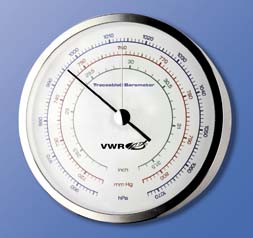
VWR® Traceable™ Precision Dial Barometer Triple scales provide a sensitive measure of a……...

Intuitive was founded in 1995 to create innovative, robotic-assisted systems that help empower do……...

Delta Controls is unique among manufacturers of process equipment and instrumentation.Delta Contr……...
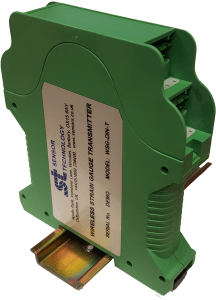
The wireless strain gauge (WSG) transmitter series is designed to turn any manufacturers’ s……...
The SILVA ClinoMaster is a hand-held instrument for measuring vertical angles. ClinoMaster is ava……...
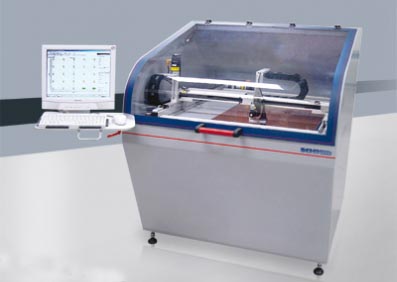
The panel measuring table supplies fast information on the etching distribution after differential etching processes or on the thickness of copper plating. The measurements are carried out fully au……

Oakton Temp-300 Dual-Input Thermocouple Datalogging Thermometer logs up to 2000 sets of readings in real time with date and time stamp. USB output lets you transfer data to your computer. Automatic……

Monnit Corporation was established to capitalize on the emerging trend of connecting to, monitoring and controlling machines and other “things” in our environment. Their backgrounds in ……